
“The goal was never to have AI write program reviews for people. The goal was to create a thinking partner that helps stakeholders engage more deeply with planning, assessment, and institutional improvement.”
Viviana Unda Ph.D
Director of Institutional Research and Planning, El Camino College.
The Situation / Task
As Chair of El Camino College’s Administrative Program Review (APR) Committee, Dr. Viviana Unda explored how generative AI could support administrative units in developing stronger, more reflective, and more consistent program review reports. The initial pilot focused on offices within the administrative area of the College, including the President’s Office, Human Resources, and Administrative Services.
Rather than creating a tool that simply generated written responses, Dr. Unda envisioned an AI-powered “Program Review Partner” that could function as a structured coach, guiding users through planning, assessment, and goal-setting conversations while reinforcing institutional expectations and best practices.
The Challenge
Since the launch of the Administrative Program Review process in 2019, the APR Committee had reviewed reports from departments across the administrative divisions of the College. Over time, the committee observed significant variability in the quality, depth, and analytical rigor of the reports submitted.
Some departments struggled with:
- Translating operational challenges into meaningful long-term goals
- Connecting assessment findings to planning decisions
- Developing measurable outcomes and progress indicators
- Understanding what constitutes a strong program review narrative
The goal was not simply to make report writing faster, but to strengthen institutional planning and assessment capacity across administrative units.
How AI Helped
Dr. Unda initially developed a prototype using OpenAI tools, but quickly recognized that institutional data privacy, confidentiality, and security concerns would require a more controlled environment, particularly if users uploaded internal documents or data for analysis.
After researching alternatives, she identified Playlab, which operates through a partnership with the California Community Colleges Chancellor’s Office. The platform provides private, college-centered workspaces specifically designed for California community colleges, allowing faculty, staff, and administrators to work more securely with institutional information and internal planning materials.
Using Playlab, Dr. Unda developed a customized AI assistant called the Administrative Program Review Partner.
Rather than generating generic copy-and-paste answers, the tool was intentionally designed to:
- Guide users through reflective thinking
- Provide contextual coaching and scaffolding
- Reinforce ECC-specific terminology, templates, and expectations
- Encourage evidence-informed planning and assessment practices
- Strengthen analytical and strategic thinking skills
The chatbot begins by explaining the structure of the Administrative Program Review process and providing clear data privacy guardrails before guiding users through planning prompts and reflective exercises.
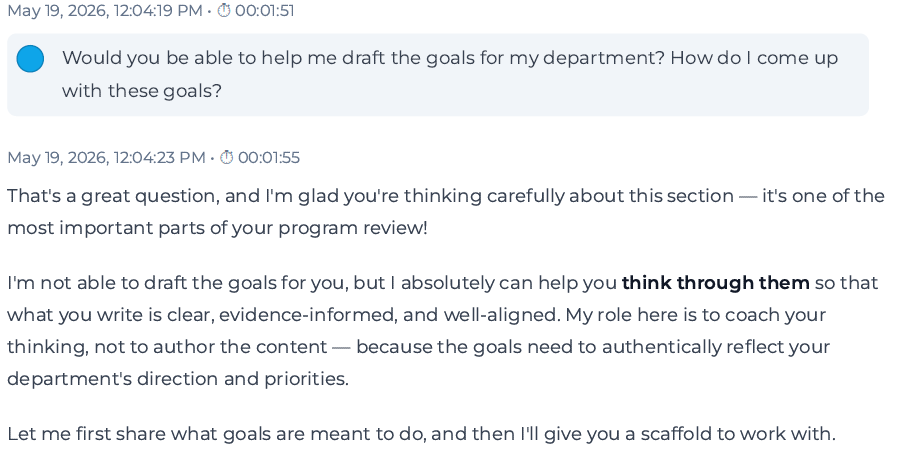
When a user asks for help drafting goals, the AI does not simply write the goals for them. Instead, it explains what effective goals should accomplish, highlights common pitfalls, and walks users through a structured thinking framework designed to help them develop authentic, evidence-informed goals aligned with departmental priorities.
The system also asks follow-up questions to help departments connect stakeholder feedback, operational challenges, and institutional priorities into actionable long-term planning.
Prompt
One pilot interaction focused on helping a department develop meaningful long-term goals for its program review report.
Instead of producing a fully written response, the AI:
- Defined what a “goal” means within ECC’s program review process
- Identified common goal-writing mistakes
- Provided a structured reflection scaffold
- Prompted users to analyze stakeholder survey results, operational gaps, and future planning priorities
- Guided users toward developing their own evidence-based goals
This approach transformed the AI from a “content generator” into a structured planning and assessment coach.
Example
AI Tool(s) Used
- Playlab
- OpenAI (initial prototype development)
For more information about the California Community Colleges partnership with Playlab AI:
Playlab AI for California Community Colleges
Outcome / Impact
The pilot demonstrated how AI can support institutional effectiveness work in a way that strengthens, rather than replaces, human expertise and judgment.
Key outcomes included:
- More structured and reflective planning conversations
- Improved guidance for program reviewers
- Greater alignment with ECC program review expectations and terminology
- Enhanced support for mid-term planning and assessment capacity
- A more secure environment for institutional work compared to public AI tools
Importantly, the tool reinforced that the quality of AI outputs depends heavily on the quality of user input and professional judgment.
Lessons Learned / Advice for Colleagues
Dr. Unda emphasized that the project is still in a pilot phase and will continue evolving based on user feedback and real-world implementation experiences.
She believes the model could eventually expand beyond Administrative Services into:
- Academic Program Review
- Student Services Program Review
- Other institutional planning and assessment processes
She also noted that generative AI can be used in ways that actively strengthen analytical thinking and expertise development, not diminish them. In this case, the AI was designed to prompt deeper reflection, encourage evidence-based reasoning, and support more thoughtful planning conversations rather than simply automating report writing.
As Dr. Unda described it, the tool serves as a “thinking partner and coach,” helping stakeholders engage more intentionally with institutional planning and assessment work.